In this article
Oxygen is one of a steam boiler’s worst enemies. Dissolved in feedwater, it attacks boiler tubes, economisers and feed lines, causing pitting corrosion that can perforate metal long before the rest of the boiler is worn out. A deaerator is the piece of boiler house equipment designed to remove that oxygen, along with other dissolved gases, before the water reaches the boiler.
This guide explains how a deaerator works, when a plant needs one rather than a simple hot feedtank, how deaerators are sized and controlled, and what to look for in a good installation. It is written for plant engineers, boiler house managers and project owners planning new steam plant or upgrading an existing boiler house.
Why remove oxygen from feedwater?
Spirax Sarco’s guidance explains that oxygen in boiler water causes pitting corrosion. Carbon dioxide, also present in feedwater, forms carbonic acid in condensate lines and attacks pipework further down the system. The US Department of Energy’s steam tip sheet on deaerators notes that a deaerator removes oxygen and carbon dioxide by heating the water to saturation temperature and stripping out the released gases.
Oxygen can be dealt with in three ways, and most plants use a combination:
- Heating the feedwater, because gases are less soluble in hot water.
- Chemical oxygen scavengers, dosed into the feedwater.
- Mechanical deaeration in a pressurised deaerator, which brings oxygen down far enough to reduce or largely avoid scavenger use.
How a deaerator works
The principle is straightforward. The solubility of a gas in water falls as the water approaches its boiling point. Spirax Sarco puts it this way: at saturation temperature the solubility of a gas is effectively zero, but the water must be agitated, broken up or boiled for the gas to escape.
In a typical pressurised deaerator:
- Water is sprayed into the deaerator head (dome) through nozzles that break it into fine droplets, giving a large surface area.
- Steam enters the head through a diffuser and surrounds the droplets, heating them quickly to saturation temperature.
- Released gases rise and leave through a vent with a small amount of steam.
- The deaerated water falls into a storage vessel below, where a steam blanket above the water stops gases being reabsorbed.
Designs vary. Some use spray nozzles only, others add trays or packed sections to increase contact between steam and water. The DOE notes that steam may flow parallel to, across or against the water flow depending on the design.
Operating pressure
Spirax Sarco states that a pressurised deaerator is often designed to operate at about 0.2 bar g, giving a saturation temperature of around 105°C. Operating slightly above atmospheric pressure keeps the water at a temperature where very little oxygen can remain dissolved.
Deaerator or hot feedtank?
Many smaller boiler houses use an atmospheric feedtank, heated with steam to around 85–90°C. Spirax Sarco notes that this still leaves roughly 2 mg/litre (ppm) of oxygen, which must then be removed with a chemical scavenger. A pressurised deaerator aims to reduce oxygen below 20 parts per billion without chemicals.
The DOE tip sheet gives a sense of the targets: most high-pressure boilers need oxygen at 5 ppb or lower, while low-pressure boilers may tolerate more, though keeping oxygen low extends equipment life.
When does a deaerator make sense? Factors include:
| Factor | Favours a pressurised deaerator | A hot feedtank may be enough |
|---|---|---|
| Boiler pressure | Higher-pressure plant; Spirax Sarco suggests above about 20 bar g a vented feedtank loses too much steam | Lower-pressure boilers |
| Boiler type | Water-tube boilers, economisers and superheaters, which are sensitive to oxygen | Many shell (fire-tube) boilers |
| Make-up water | High proportion of cold make-up | High condensate return |
| Chemicals | Need to minimise scavenger use, e.g. in food plants with steam contacting product | Chemical treatment acceptable |
| Steam output | Larger boiler houses | Smaller installations |
For many Nigerian food, beverage and manufacturing plants, where boilers run long hours on make-up water drawn from boreholes, good feedwater deaeration is a significant part of protecting the boiler investment.
Sizing a deaerator
Deaerator sizing is a job for the supplier and your engineer, but owners should understand the inputs:
- Maximum feedwater flow, based on the total boiler output at full load plus blowdown.
- Inlet water temperatures of condensate return and make-up. The DOE recommends using the lowest expected incoming water temperature in heat balance calculations, because cold make-up needs the most steam.
- Proportion of make-up versus condensate.
- Operating pressure of the deaerator.
- Storage capacity. Spirax Sarco notes the vessel typically holds between 10 and 20 minutes of water storage for the boiler on full load.
- Turndown. The spray system must still atomise well at low flows; some designs use multiple heads for wide flow ranges.
From these, the supplier calculates the steam needed to heat the water to saturation and sizes the steam control valve, water control valve and vent.
Venting
The vent carries away released gases, inevitably with some steam. Spirax Sarco reports that manufacturers typically recommend a venting rate of between 0.5 and 2 kg of steam/air mixture per 1,000 kg/h of deaerator capacity, often set manually with a part-open valve. Too little venting leaves gases in the water; too much wastes steam.
Controls
Two control loops keep a deaerator working properly.
Pressure control
A modulating steam valve, driven by a pressure controller, holds the vessel at its set pressure. Spirax Sarco prefers a fast-acting pneumatic actuator, and advises against simple direct-acting valves where load varies considerably. The DOE stresses a dedicated pressure-regulating valve to keep pressure constant, because sudden pressure changes can allow oxygen back into the water.
Level control
A modulating water valve, controlled by a level probe, holds the storage level steady. Spirax Sarco notes that on/off level control upsets pressure control, because slugs of cold water cause the pressure to collapse.
Deaerator installation
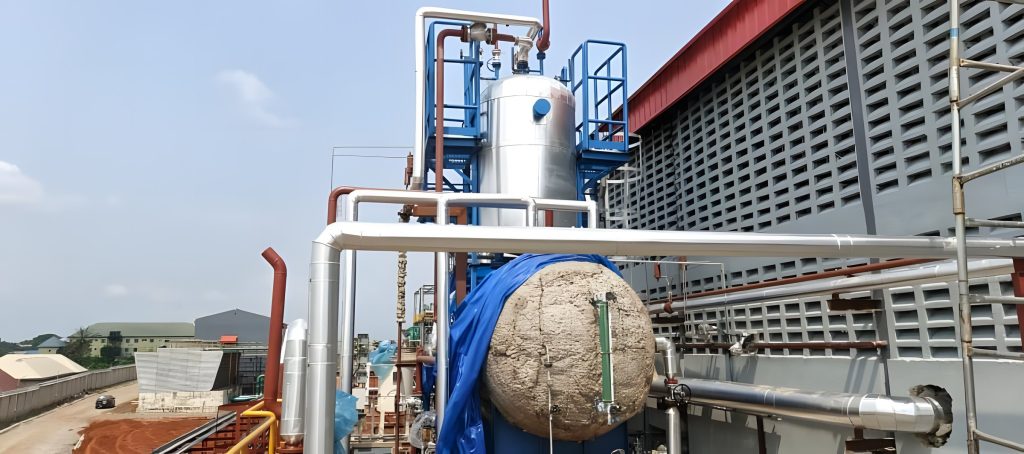
A deaerator is a pressure vessel and should be installed as one.
Elevation and pump suction
Water in a deaerator is at saturation temperature, so it will flash to steam in the pump suction if the pressure falls. The DOE notes that the deaerator also provides the net positive suction head needed at the boiler feed pump inlet. That is why deaerators are mounted high, on a structure above the feed pumps. The required height comes from the pump manufacturer’s NPSH requirements plus suction line losses. Keep the suction line short, generously sized and free of unnecessary fittings.
Supporting structure
The structure must carry the vessel full of water, with platforms and ladders for safe access to valves, gauges and the vent. Wind and seismic loads, where relevant, and thermal movement of connected pipework should be considered.
Water supply pressure
Spray nozzles need enough pressure to atomise. Spirax Sarco states that water supply pressure to the deaerator should be at least 2 bar. That usually means a transfer pump from a low-level feedtank or condensate tank.
Safety devices and pipework
- A correctly sized safety valve to protect the vessel.
- Overflow protection to prevent flooding back into the steam line.
- Vacuum protection, since the vessel can draw a vacuum when cooled.
- Pressure gauge, thermometer and sight glass or level indicator.
- Insulation on the vessel and all hot pipework. The DOE recommends insulating the deaerator section, storage tank and associated piping.
Avoid air leaks on the suction side
The DOE warns that a deaerator removes dissolved oxygen, not air drawn in through loose pump suction connections or worn packing. Check these as part of commissioning.
Regulatory note
Nigeria’s Boiler and Pressure Vessel Regulations, 2018, made under the Factories Act, require pressure vessels to be inspected periodically. A pressurised deaerator should be included in your pressure equipment register and inspection plan.
Operation and maintenance checklist
- Check pressure and temperature match: if temperature is below saturation for the gauge pressure, deaeration is poor.
- Check vent plume is steady and set as commissioned.
- Test dissolved oxygen in feedwater regularly; the DOE recommends continuous monitoring where possible.
- Inspect spray nozzles for blockage or wear.
- Inspect the vessel internally for corrosion during statutory inspection.
- Re-examine steam requirements after changes to condensate return or heat recovery.
Common mistakes to avoid
- Mounting the deaerator too low to save on structural steel, then fighting feed pump cavitation for years.
- Using on/off level control, so cold water slugs collapse the pressure and oxygen removal suffers.
- Closing the vent to “save steam”, leaving released gases in the water.
- Sizing the steam supply on average rather than coldest make-up conditions.
- Feeding the spray head from a pump that cannot deliver enough pressure for good atomisation.
- Leaving the vessel and pipework uninsulated.
- Treating the deaerator as a simple tank and leaving it out of pressure vessel inspections.
FAQ
Do we still need chemicals with a deaerator?
Often a small residual scavenger dose is kept as a safety margin, but much less than with a hot feedtank alone. Your water treatment specialist should set the regime.
Why is our deaerator not removing oxygen?
Common causes are low pressure, insufficient venting, blocked spray nozzles, on/off level control or air leaking into pump suctions.
Why is the deaerator mounted so high?
To give the boiler feed pump enough suction head so hot water does not flash to steam in the pump and cause cavitation.
Is a deaerator the same as an economiser?
No. A deaerator removes dissolved gases. An economiser recovers heat from flue gases to preheat feedwater. Many plants have both.
Talk to Maven about your boiler house
Maven Technical Services installs boilers, feedwater systems, pressure vessels and the steel structures and piping that support them. If you are planning a new boiler house, adding a deaerator or tackling corrosion in an existing plant, speak to Maven’s engineers about feedwater treatment and installation.