In this article
- Why is solar for factories growing in Nigeria?
- How does a factory solar system work?
- Which type of solar for factories suits your plant?
- How do you size solar for factories?
- Is your roof ready?
- What does installation involve?
- What does solar for factories cost?
- How do you estimate savings and payback?
- Can you finance a factory solar system?
- How do you maintain solar for factories?
- Which mistakes should you avoid?
- Frequently asked questions about solar for factories
- Start with your load data
Solar for factories means using photovoltaic panels, usually on the factory roof, to supply part of the plant’s daytime electricity. However, in Nigeria, it rarely replaces generators completely. Instead, it cuts the diesel or gas they burn during daylight hours. For plants that run day shifts on self-generated power, that saving often repays the system within a few years.
After all, energy is one of the largest costs in Nigerian manufacturing. So more owners now look at their roofs as a power source. This guide explains how solar for factories works, how to size it and what to check before you sign.
Why is solar for factories growing in Nigeria?
Three pressures drive the change.
First, diesel is expensive. For example, every kilowatt-hour from a diesel generator costs far more than a kilowatt-hour from the sun. Second, grid supply is unreliable and tariffs for industrial users have risen. Third, customers and lenders increasingly ask about carbon emissions.
Solar answers all three during the day. In addition, panels have no moving parts, so running costs are low. Once the system is built, the fuel is free.
How does a factory solar system work?
First, panels turn sunlight into direct current. Inverters then convert it into alternating current that matches the factory supply. After that, the solar power feeds the main distribution board, where it mixes with power from the grid or the generators.
A controller manages the sources. When the sun is strong, solar carries as much load as it can, and the generators back off. When clouds pass, the generators pick up the difference.
The main parts are:
- photovoltaic panels
- mounting structure
- string or central inverters
- DC and AC cabling, with isolators and protection
- a controller that works with the generators or the grid
- batteries, where the design includes storage
- monitoring equipment
Which type of solar for factories suits your plant?
There are three broad options.
| Type | How it works | Best for | Limits |
|---|---|---|---|
| Grid-tied | Works alongside the grid, no batteries | Sites with fairly steady grid supply | Stops when the grid fails, unless paired with generators |
| Solar and generator hybrid | Solar reduces the load on running generators | Sites that run generators in the day | Generators must keep a minimum load |
| Solar with battery storage | Batteries store energy for later | Critical loads, evening use, weak supply | Highest capital cost |
Most Nigerian factories start with a fuel-saver hybrid. In other words, the solar plant works with the existing generators and cuts their fuel use. Batteries can follow later, as prices fall.
One technical point matters here. For example, a diesel generator must not run at very low load for long. Therefore, the controller limits how much solar the system accepts, so that the generators stay above their minimum. A good designer explains this limit clearly.
How do you size solar for factories?
In short, sizing starts with data, not with roof area.
- Record the load. Log the plant’s power demand through the day, for at least a week. Hourly readings are best.
- Find the daytime base load. This is the demand that is always present between about nine and four.
- Check the generator limits. Note the minimum load for each set.
- Measure the usable roof. As a rough guide, one kilowatt of panels needs six to eight square metres.
- Estimate the yield. In most of Nigeria, each kilowatt of panels produces roughly three and a half to four and a half kilowatt-hours a day, with more in the north.
- Match size to load. So choose a capacity that the plant can use fully on a normal working day.
Oversizing wastes money, because surplus energy has nowhere to go unless the system has batteries or an export agreement. For that reason, a system matched to the daytime load gives the best return.
Is your roof ready?
Most solar for factories goes on the roof. After all, the roof carries the plant for 25 years. So check it before anything else.
Structure. Panels and frames add roughly 12 to 20 kilograms per square metre. Therefore, an engineer should confirm that the purlins, rafters and columns can carry that, plus wind uplift.
Condition. If the sheets are old or rusty, replace them first. Removing a solar array later to fix a roof is expensive.
Type. Standing seam and trapezoidal metal roofs take clamps or brackets easily. Old asbestos or fibre cement sheets need special care, and installers often avoid fixing to them.
Orientation and shade. In Nigeria, panels work best facing south at a low tilt. In addition, chimneys, silos, trees and taller buildings cast shade, and even partial shade cuts output.
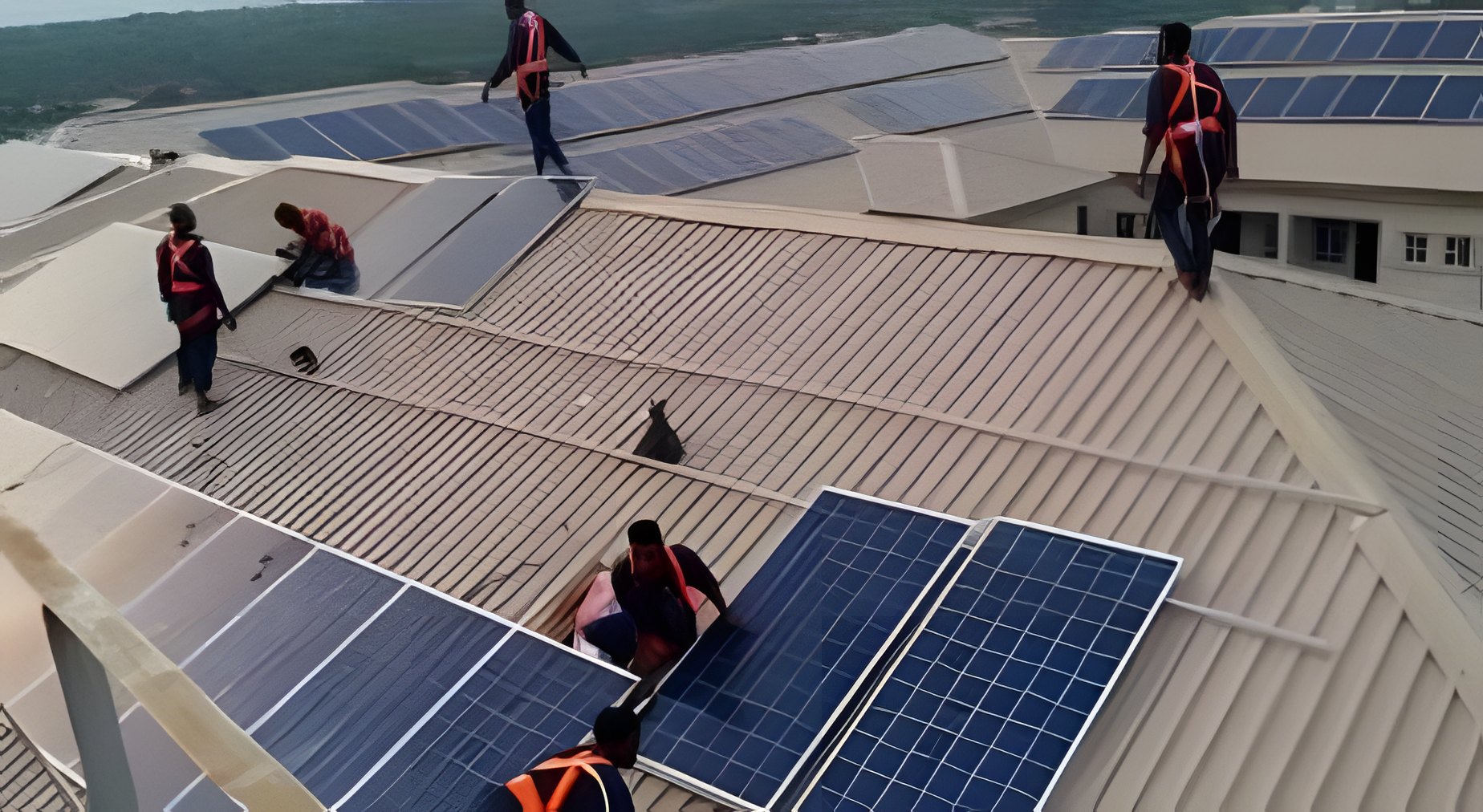
Access and safety. Installers and cleaners need safe routes, walkways and anchor points.
Where the roof is unsuitable, ground-mounted frames or solar carports are good alternatives.
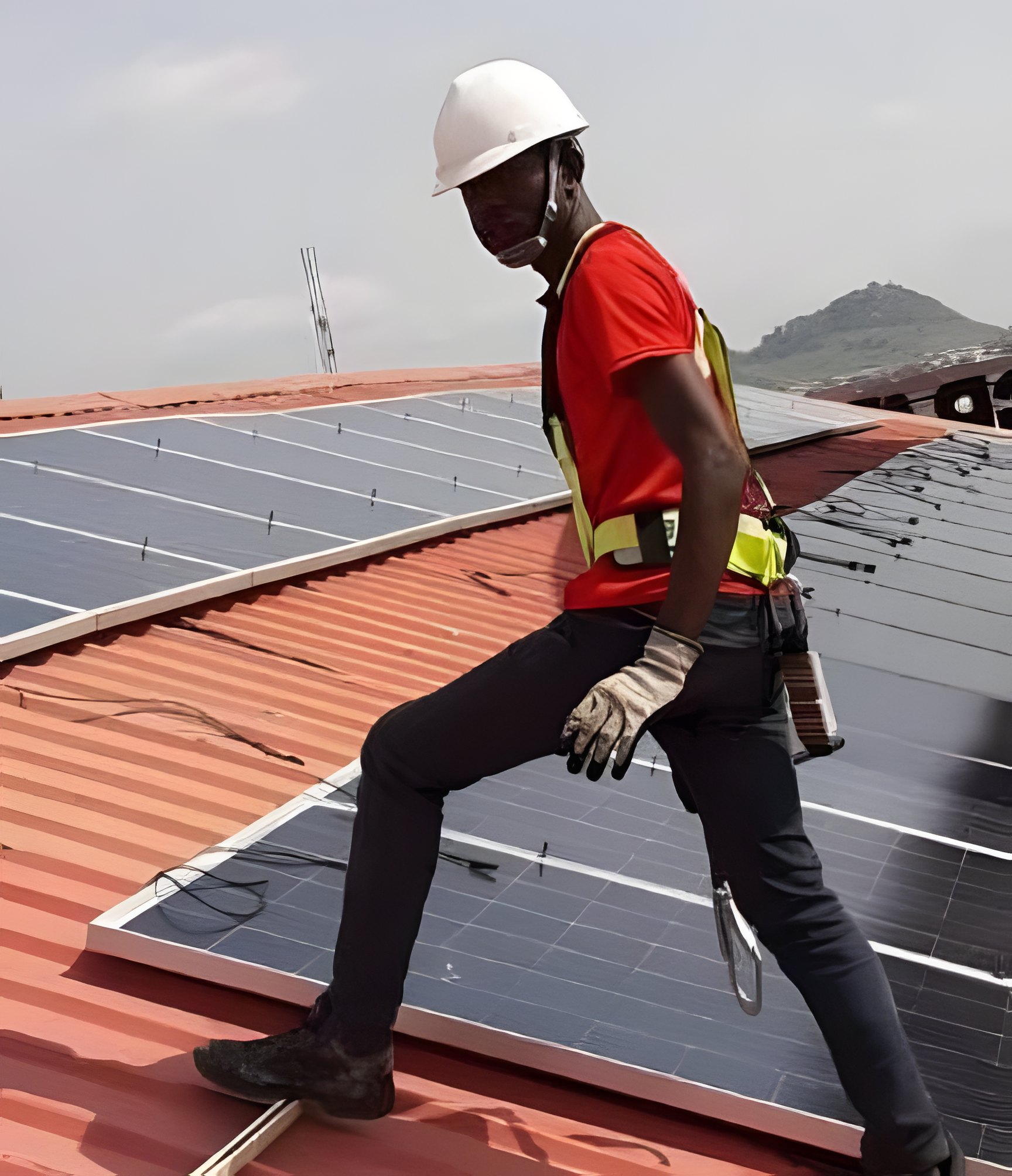
What does installation involve?
A typical solar for factories project follows these stages.
- Site survey and load study. Engineers collect data and inspect the roof and switchgear.
- Design. The team produces layouts, structural checks, single line diagrams and a yield estimate.
- Procurement. Panels, inverters, structures and cables arrive on site.
- Mounting structure. Installers fix rails and brackets, and seal every roof penetration.
- Panels. The crew lays, clamps and earths the panels.
- Electrical work. Electricians run DC and AC cables, install inverters and connect to the distribution board.
- Controls. The controller links solar with the generators or the grid.
- Testing and commissioning. The team tests insulation, polarity, earthing and protection, and then switches on.
- Training and handover. Staff learn to read the monitoring system and to isolate the plant safely.
However, steelwork quality matters as much as the electronics. In fact, corroded frames, loose clamps and leaking roof fixings cause most long-term problems. Therefore, use galvanised or aluminium structures and stainless fasteners.
What does solar for factories cost?
Prices depend on system size, equipment brand, roof difficulty and exchange rates, so no single figure holds for long. Still, the cost falls into clear parts.
- Panels. A large share, although panel prices have fallen steadily for years.
- Inverters and controls. These are the brains of the plant.
- Mounting structure. The cost rises with roof complexity and wind zone.
- Cables, protection and switchgear. Often underestimated.
- Installation and engineering. This covers skilled labour, lifting and testing.
- Batteries. If included, they can be the largest single item.
As a rule, larger systems cost less per kilowatt than small ones. Batteries, by contrast, add a great deal. So decide early whether you truly need night-time supply from solar.
How do you estimate savings and payback?
The method is simple.
First, estimate the yearly energy the system will produce and the plant will use. Then multiply it by what that energy costs today. For a plant on diesel generators, use the fuel cost per kilowatt-hour, plus some saved maintenance. For a plant on the grid, use the tariff.
Finally, divide the system cost by the yearly saving. That gives the simple payback in years.
Plants that displace diesel usually see the shortest payback, often between two and five years. By contrast, plants that displace cheaper grid or gas power take longer. In every case, ask the supplier to show the assumptions behind the numbers. The International Renewable Energy Agency publishes independent data on solar costs and performance.
Can you finance a factory solar system?
Yes. Solar for factories no longer needs a large cash payment up front. There are three common routes.
- Outright purchase. The factory pays the capital cost and keeps all the savings.
- Lease to own. The factory pays in instalments and owns the plant at the end.
- Power purchase agreement. A developer owns the plant and sells the energy to the factory at an agreed rate.
In most cases, each route suits a different balance sheet. So compare the total cost over the contract, not just the monthly figure.
How do you maintain solar for factories?
Solar needs little maintenance, but it does need some.
- Clean the panels. Dust cuts output, especially in the harmattan months. Wash with clean water and soft brushes.
- Watch the monitoring. For example, a sudden drop in one string points to a fault.
- Inspect the roof fixings. Check for loose clamps, corrosion and leaks every year.
- Check the electrical parts. Tighten connections, test protection and clean inverter filters.
- Trim nearby trees. New shade appears slowly.
Which mistakes should you avoid?
- sizing the system to the roof instead of the load
- ignoring the minimum load of the generators
- fixing panels to a roof that needs replacing
- skipping the structural check
- choosing the cheapest panels with no traceable warranty
- leaving no walkways for cleaning
- neglecting earthing and surge protection
Frequently asked questions about solar for factories
Can solar power run a whole factory?
In daylight, solar can carry a large share of the load. However, most factories still need the grid, generators or batteries for nights, cloudy periods and heavy starting loads.
How much roof space does factory solar need?
Allow roughly six to eight square metres for each kilowatt of panels. A 500 kilowatt system therefore needs about 3,000 to 4,000 square metres of sound roof.
How long do solar panels last?
In addition, good panels carry performance warranties of 25 years or more. Inverters usually last 10 to 15 years, so plan for one replacement.
Does solar work in the rainy season?
Yes, although output falls on overcast days. Yearly yield estimates already allow for the wet months.
Start with your load data
Solar for factories works best when the design follows the load, the roof and the existing generators. So begin with a proper survey, and insist on clear numbers.
Maven Technical Services installs solar arrays and street lighting for industrial, commercial and government clients. See our solar installations, or send us your load profile and our engineers will advise on the right system.