In this article
- What is structural steel fabrication used for?
- Why choose structural steel fabrication over concrete?
- The stages of structural steel fabrication
- How do you protect steel from corrosion?
- How is the steel erected on site?
- Bolted or welded site connections?
- Which quality documents should you ask for?
- Which standards apply to structural steel fabrication?
- What affects the cost of structural steel fabrication?
- How do you choose a structural steel fabrication company?
- Frequently asked questions about structural steel fabrication
- Build it right in the workshop
Structural steel fabrication is the process of turning raw steel sections and plates into finished frames, platforms, supports and buildings. First, fabricators cut, drill, fit, weld and coat the steel in a workshop. Then an erection crew assembles it on site. Done well, it gives a strong structure that goes up quickly and lasts for decades.
As a result, industrial plants in Nigeria depend on steel for warehouses, pipe racks, mezzanines, equipment supports, chimneys and tank towers. This guide explains each stage of structural steel fabrication and shows what separates good work from poor work.
What is structural steel fabrication used for?
Steel suits almost any structure that must be strong, fast to build and easy to change later. Common examples include:
- factory and warehouse frames
- mezzanine floors and office platforms
- pipe racks and pipe bridges
- equipment supports and skids
- access platforms, stairs, ladders and handrails
- conveyor gantries and bucket elevator towers
- tank stands and water towers
- chimney and silo support structures
- generator and equipment enclosures
Why choose structural steel fabrication over concrete?
Each material has strengths. The table compares them for industrial use.
| Factor | Steel structure | Reinforced concrete |
|---|---|---|
| Speed on site | Fast, because parts arrive ready | Slower, needs formwork and curing |
| Weight | Lighter, so foundations are smaller | Heavier |
| Long spans | Easy to achieve | Costly |
| Changes later | Simple to extend or modify | Difficult |
| Quality control | Workshop conditions | Depends on site work |
| Fire resistance | Needs protection | Naturally good |
| Corrosion | Needs coating | Rebar needs cover |
For most plant structures, steel wins on speed and flexibility. However, it must have proper corrosion protection, especially near the coast.
The stages of structural steel fabrication
A project moves through nine stages. Each one affects the next.
1. Design and engineering
The structural engineer calculates the loads and sizes the members. Loads include the weight of the structure, equipment, people, stored goods, wind and, where relevant, crane and vibration loads.
2. Shop drawings
Next, detailers turn the design into shop drawings. In addition, these show every beam, column, plate, hole and weld, each with a part mark. They also produce erection drawings and a bolt list. Good detailing prevents most site clashes. So check and approve the drawings before any steel is cut.
3. Material procurement
The fabricator buys sections and plates to the grades on the drawings. Common grades include S275 and S355 to European standards, or ASTM A36 and similar. In most cases, each batch should come with a mill test certificate that states its chemistry and strength.
Traceability matters here. However, the Nigerian market holds steel of mixed origin and quality. Therefore, a careful fabricator checks dimensions and certificates on arrival and rejects doubtful material.
4. Cutting
Workers cut members to length with saws, and they cut plates with oxy-fuel, plasma or CNC machines. Accurate cutting makes fit-up easy later. In contrast, rough cutting leaves gaps that welders then have to fill.
5. Drilling and preparation
Holes for bolts go in by drilling or punching. In addition, edges that need full penetration welds get a bevel. After that, workers grind away burrs and sharp edges, because paint does not cover sharp corners well.
6. Fit-up and assembly
Fitters set the parts in position on a level bench or jig. Then they tack weld them and check dimensions, squareness and camber against the drawing. Still, errors are cheap to fix at this stage. Later, they are expensive.
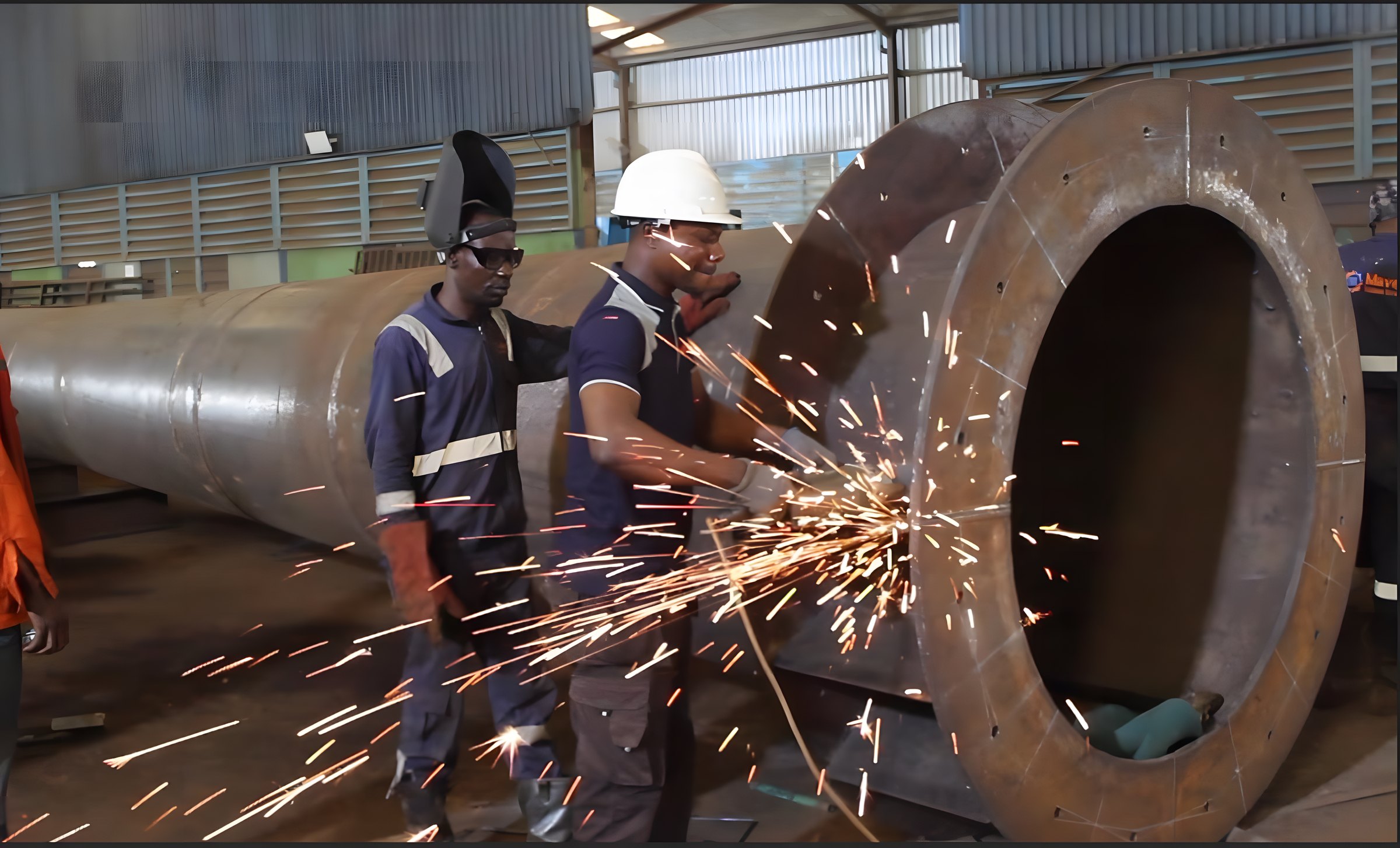
7. Welding
Qualified welders complete the joints to an approved welding procedure. In fabrication shops, the common processes are stick welding and MIG or flux-cored welding. The welder controls the sequence, so that heat does not distort the member.
8. Inspection
Inspectors check every weld visually for size, profile and defects. For critical joints, they add non-destructive testing, such as dye penetrant, magnetic particle or ultrasonic tests. We explain these methods in our guide to weld inspection. The team also checks final dimensions before coating.
9. Surface preparation and coating
Finally, the steel gets its corrosion protection. This stage decides the life of the structure, so it deserves its own section.
How do you protect steel from corrosion?
Nigeria’s humidity is hard on steel, and coastal air in Lagos and Port Harcourt is harder still. So choose the protection system to suit the environment.
Surface preparation. First, paint only lasts on clean steel. Abrasive blasting removes mill scale and rust and gives the surface a profile that paint can grip. However, wire brushing alone is rarely enough for long life.
Paint systems. A typical industrial system has a zinc-rich or epoxy primer, an epoxy build coat and a polyurethane top coat. The specification states the dry film thickness, and an inspector measures it with a gauge.
Hot-dip galvanising. First, the fabricator dips the finished steel in molten zinc. Galvanising protects inside hollow sections and at edges, and it needs little maintenance. As a result, it suits platforms, gratings, handrails, towers and outdoor structures.
Duplex systems. Paint over galvanising gives the longest life in harsh conditions.
Always touch up damage after transport and erection. Otherwise, rust starts at the scratches.
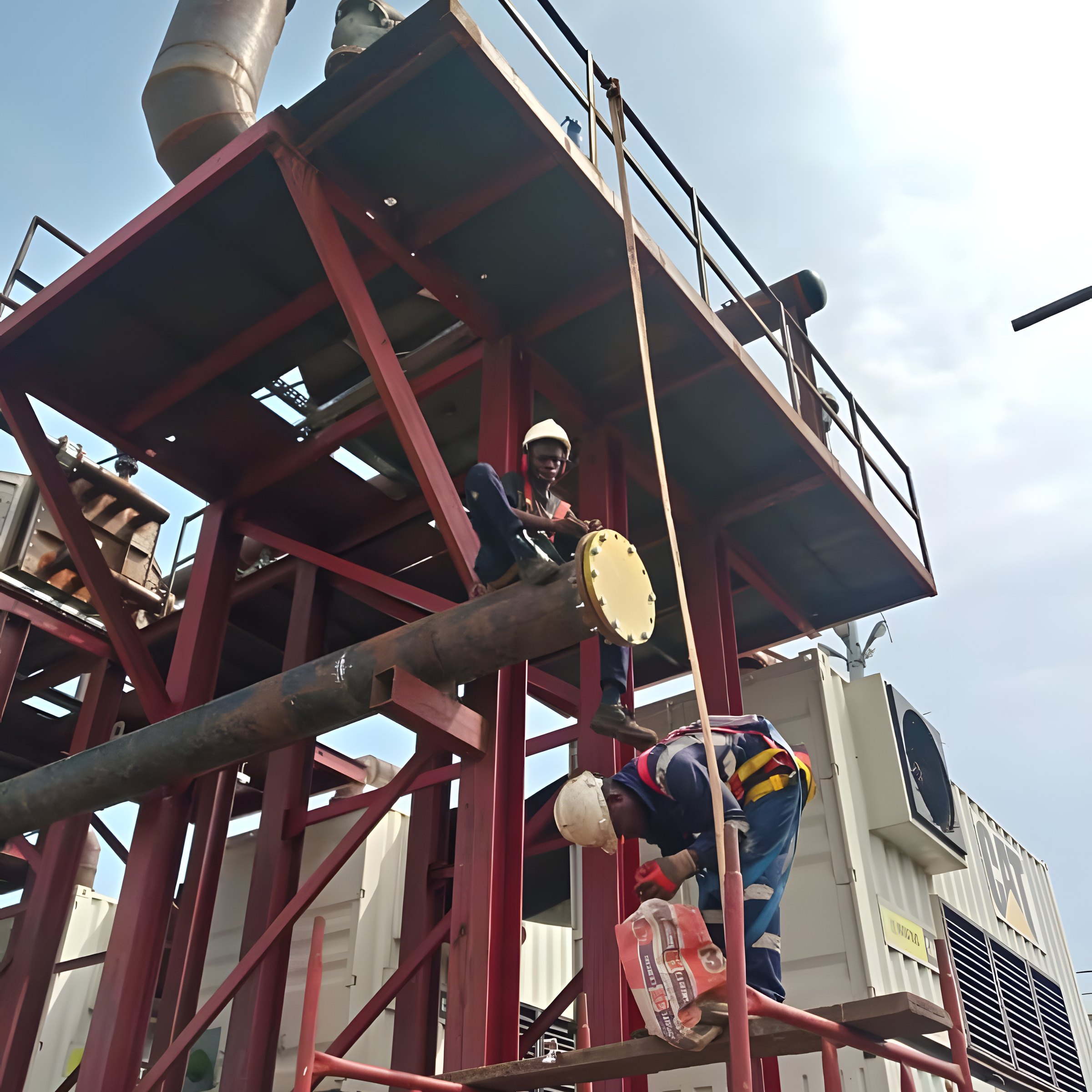
How is the steel erected on site?
In short, erection turns the fabricated parts into a structure. It follows a plan.
- Check the foundations. The crew surveys anchor bolt positions and levels before delivery.
- Deliver in sequence. Steel arrives in the order the crew needs it.
- Lift and place. Cranes lift columns first, and then beams and bracing.
- Align and plumb. The team checks the frame for line, level and plumb.
- Bolt up. Workers tighten structural bolts to the specified tension.
- Grout the bases. Non-shrink grout fills the gap under base plates.
- Fit secondary steel. Purlins, rails, stairs, gratings and handrails follow.
- Touch up coatings. Painters repair any damage.
Safety governs every step. For example, work at height needs harnesses, edge protection and a lifting plan. In addition, a trained banksman must direct every crane lift.
Bolted or welded site connections?
In practice, most modern steelwork uses bolted connections on site. Bolting is faster, it needs no welding at height, and it does not damage the coating. Workshop welding then handles the joints within each piece.
Site welding still has its place. For example, it suits modifications, tie-ins to existing steel and some heavy joints. However, it needs shelter from wind and rain, qualified welders and inspection.
Which quality documents should you ask for?
A professional fabricator hands over a data pack. Ask for it in the contract.
- approved shop drawings and as-built drawings
- mill test certificates for the steel
- welding procedure specifications and welder qualification records
- inspection and test plan, signed at each stage
- non-destructive test reports
- dimensional check reports
- coating records, including dry film thickness readings
- bolt tightening records
These documents prove that the structure matches its design. After all, insurers, regulators and future engineers will want them.
Which standards apply to structural steel fabrication?
As a rule, projects usually name one family of standards and stay with it. European practice uses the Eurocodes with EN 1090 for execution. American practice uses the codes of the American Institute of Steel Construction, with welding to AWS D1.1 from the American Welding Society. However, british Standards remain common on older Nigerian projects.
Whatever the code, the principle is the same: qualified people, approved procedures and recorded inspection.
What affects the cost of structural steel fabrication?
Fabricators normally price by the tonne. Yet several factors change the rate.
- Steel price. It follows world markets and exchange rates.
- Complexity. Many small, detailed parts cost more per tonne than long, simple beams.
- Coating. Blasting and a three-coat system, or galvanising, add a clear cost.
- Testing. A higher percentage of non-destructive testing costs more.
- Transport. Long or wide loads need escorts and permits.
- Site conditions. Height, access and working around a live plant affect erection.
- Programme. A very short schedule needs extra shifts.
So send complete drawings and a clear specification when you ask for quotes. Then the offers will be comparable.
How do you choose a structural steel fabrication company?
Visit the workshop before you award the job. Look for the following.
- a covered, organised workshop with lifting equipment
- its own qualified welders, not just casual labour
- in-house detailing or a reliable detailing partner
- written quality procedures and sample data packs
- a safety record and visible safety habits
- completed projects of similar size that you can inspect
- the capacity to deliver within your programme
Our guide on how to choose an engineering contractor in Nigeria gives a fuller checklist.
Frequently asked questions about structural steel fabrication
How long does structural steel fabrication take?
A small platform can take one to two weeks. A medium warehouse frame often takes six to ten weeks from approved drawings to delivery, depending on size and coating.
What grade of steel is used for structures?
Most structures use mild structural steel, such as S275 or S355, or the ASTM equivalent. In most cases, the engineer selects the grade from the loads.
Is galvanising better than painting?
Galvanising usually lasts longer with less maintenance, especially outdoors. Painting costs less at first and allows any colour. In harsh sites, the two together work best.
Can a steel structure be extended later?
Yes. That is one of steel’s main advantages. An engineer checks the existing frame and foundations, and then the fabricator adds new bays or floors.
Build it right in the workshop
Good structural steel fabrication rests on accurate drawings, certified material, qualified welding, proper coating and careful erection. When each stage has a record, the structure earns its long life.
Maven Technical Services fabricates and erects steel structures from our own facility in Lagos, with certified welders and experienced engineers. See our workshop fabrication projects, or send us your drawings for a method, a schedule and a price.