In this article
- What a chimney actually does
- Sizing: height and diameter
- Types of steel chimney
- How industrial chimney fabrication works
- Choosing the steel
- Coatings and corrosion in industrial chimney fabrication
- Erecting the chimney safely
- Accessories that matter
- What drives the cost of industrial chimney fabrication
- Maintenance after industrial chimney fabrication
- Working with the boiler supplier
- Why fabrication and erection belong together
- Talk to us
Every fired boiler needs a chimney. It carries flue gas safely away, creates draught and disperses exhaust above people and buildings. Yet the chimney is often treated as an afterthought, ordered late and built quickly. That is a mistake. In fact, good industrial chimney fabrication affects boiler performance, safety and the look of the whole site for decades.
We fabricate and erect steel chimneys for boiler plants across Nigeria and West Africa. Recent examples include a 33 metre chimney for a biomass boiler at Dufil in Port Harcourt and a 30 metre stack for a waste heat recovery boiler in Benin City. This guide explains how the work is done and what to look for.
What a chimney actually does
A chimney does three jobs.
It creates draught. Hot gas is lighter than the air around it, so it rises. A tall column of hot gas pulls air through the boiler. On some boilers, this natural draught does part of the work. On others, fans do most of it, and the chimney simply needs to avoid adding resistance.
It disperses flue gas. The higher the release point, the more the exhaust mixes with air before it reaches the ground. As a result, people, air intakes and neighbouring buildings are protected.
It carries gas safely. Flue gas is hot and can be corrosive. So the chimney must contain it without leaks, overheating nearby structures or rusting through.
Sizing: height and diameter
Two numbers define a chimney: height and diameter. Both come from engineering, not guesswork.
Height. Height depends on the draught needed, local rules, nearby buildings and the need to disperse exhaust. A chimney that is too short can send fumes back towards people and into buildings.
Diameter. Diameter controls gas velocity. If it is too narrow, velocity rises and resistance chokes the boiler. If it is too wide, gas slows down, cools and may condense inside, which speeds up corrosion.
For example, our chimney for Prime Gate Distilleries had a top internal diameter of 800 mm and a height of 20 metres. The Green Hills stack was 1,100 mm in diameter and 30 metres tall. Each was sized for its own boiler and site.
Types of steel chimney
Most industrial boiler chimneys are steel. The main types are:
Self-supported. First, a self-supported chimney stands on its own base, with no guy wires. It saves ground space and suits busy sites. We built one for Twinings in Ikeja.
Guyed. Next, a guyed chimney uses cables anchored to the ground for stability. It needs less steel but more space around the base.
Structure-supported. Finally, some chimneys are braced against a building or steel frame.
Conical or cylindrical. In addition, chimneys can be straight or tapered. A conical chimney, like the one we built for Aspira in Kano, uses less steel towards the top and handles wind load efficiently.
How industrial chimney fabrication works
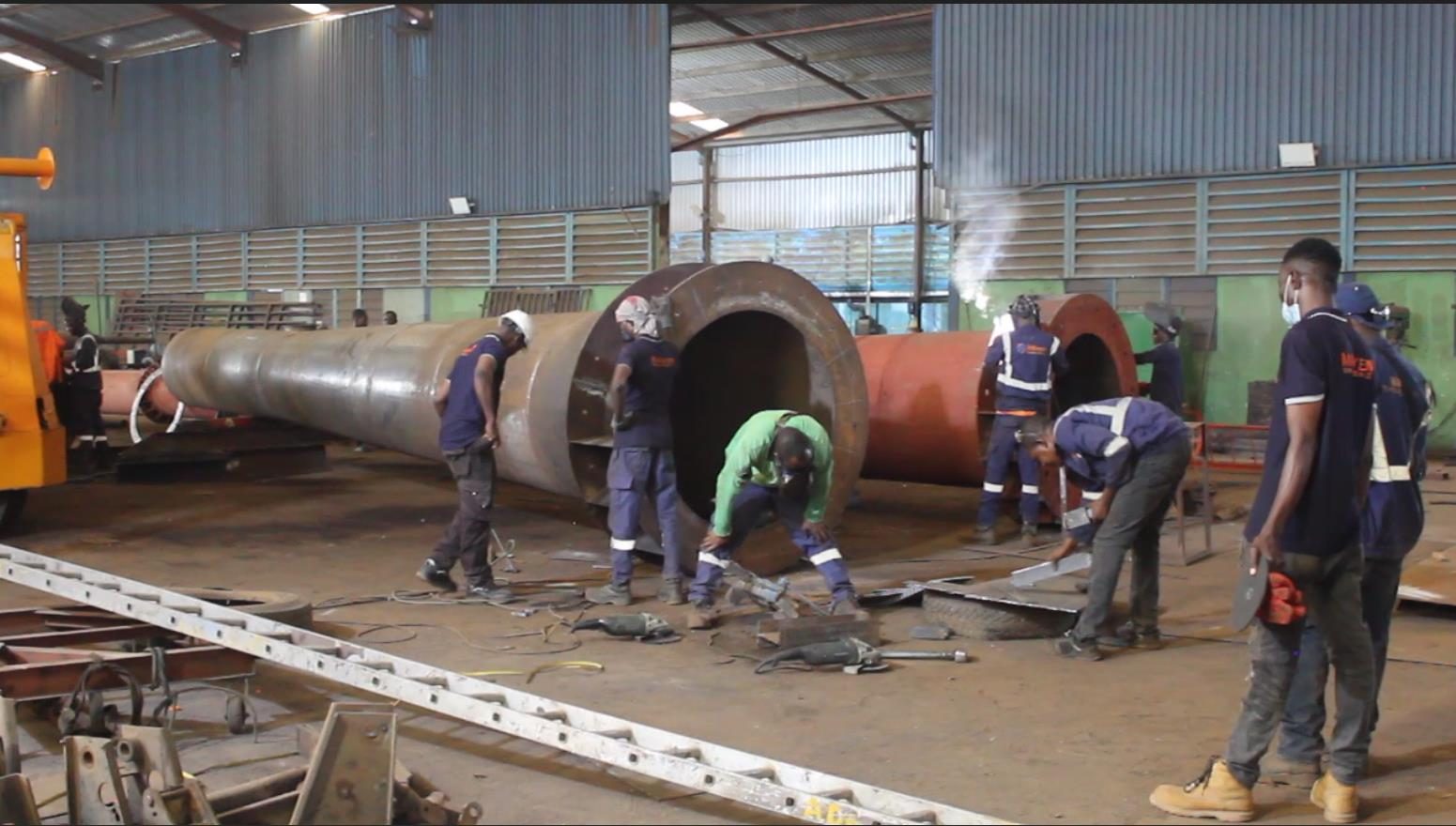
In industrial chimney fabrication, most of the work happens in the workshop, where conditions are controlled.
- Cut and roll. First, we cut steel plate to size and roll it into cylindrical or conical sections.
- Weld seams. Next, we weld the longitudinal seams to close each section.
- Add flanges or joints. Then we add flanges or joint preparations so sections can connect on site.
- Fit accessories. After that, the team adds the base plate, stiffeners, access doors, test ports, ladder brackets, platforms and lightning protection points.
- Inspect. Our inspectors check welds visually and, where required, with further testing.
- Protect. Finally, we prepare and coat the surfaces before the sections leave the workshop.
Building in sections makes transport and lifting practical. Workshop fabrication also gives better weld quality than building everything at height on site.
Choosing the steel
Most boiler chimneys use carbon steel of suitable thickness, with allowance for corrosion over the chimney’s life. Thickness depends on the diameter, height, wind load and expected service temperature.
In more corrosive duties, such as flue gas with high sulphur or a lot of moisture, other options include stainless steel liners, special coatings or thicker plate. The fuel matters here. Gas produces relatively clean flue gas. In contrast, heavy fuel oil and some biomass fuels can produce more aggressive conditions.
Coatings and corrosion in industrial chimney fabrication
In Nigeria’s climate, corrosion is the chimney’s main enemy. It attacks from both sides: rain and humidity outside, and acidic condensate inside.
Outside, a good coating system starts with proper surface preparation. Rust, mill scale and oil must go before primer. Then a heat-resistant primer and finish coat protect the steel. The finish must suit the surface temperature, since standard paint can blister on a hot stack.
Inside, the main defence is keeping flue gas above its dew point, so it does not condense. Correct sizing and insulation help. Where condensation is likely, liners or special coatings may be needed.
Erecting the chimney safely
Erection is where industrial chimney fabrication meets heavy lifting. It needs careful planning.
Foundation checks. First, confirm the foundation is cured, level and correct. Anchor bolts must match the base plate exactly.
Lifting plan. Next, plan every lift, with the crane, rigging, weights and radius worked out in advance. Mark exclusion zones on the ground.
Section by section. Then lift and join sections one at a time. Check plumb at each joint, because a small error at the base becomes a large lean at the top.
Connections. After that, bolt or weld joints to the design, and fit gaskets where required.
Final checks. Finally, confirm verticality, tighten all bolts, and fit ladders, platforms and accessories.
Wind is the main risk during erection. So lifts stop if wind speed rises above safe limits.
Accessories that matter
A chimney is more than a tube. Several accessories make it safe and useful:
- test ports, so flue gas can be sampled for emissions and combustion checks
- access doors for inspection and cleaning
- ladders and rest platforms with safety cages, for safe climbing
- aviation warning lights on tall stacks near flight paths
- lightning protection, with a sound earth connection
- a drain at the base to remove rain and condensate
- a rain cap or suitable design to limit water entry where appropriate
Leaving these out may save a little money. Yet it makes the chimney harder to inspect, test and maintain for the rest of its life.
What drives the cost of industrial chimney fabrication
Clients often ask why two chimney quotes differ so much. Usually, the answer lies in what each quote includes.
Height and diameter. First, taller and wider chimneys need more steel, more welding and bigger cranes. Cost rises faster than height, because wind load grows with height too.
Plate thickness. Next, thicker plate costs more to buy, roll and weld. Yet a thin chimney with no corrosion allowance can rust through years early, so the cheaper option is not always cheaper.
Accessories. Ladders, platforms, test ports, lights and lightning protection all add cost. However, they make the stack safe to inspect and maintain.
Coatings. A proper heat-resistant coating system with good surface preparation costs more than a quick coat of paint. It also lasts far longer.
Erection. Crane hire, rigging crews and lifting supervision can be a large share of the total, especially on tight sites.
Transport. Finally, long sections are awkward to move. Distance and road access affect the price.
When you compare quotes for industrial chimney fabrication, ask each contractor to list the plate thickness, coating system, accessories and erection method. Then compare like with like. In our experience, the lowest quote often leaves out items that the plant later needs anyway.
Maintenance after industrial chimney fabrication
Once in service, a chimney needs simple, regular care:
- Inspect the outside coating yearly and touch up damaged areas.
- Check guy wires, if fitted, for tension and corrosion.
- Inspect bolts at joints and the base for looseness and rust.
- Look inside through access doors for corrosion, deposits and liner damage.
- Clear the base drain so water does not pool.
- Test the lightning protection earth periodically.
Most chimney problems grow slowly. So a yearly inspection catches them early, when repair is simple.
Working with the boiler supplier
The boiler maker often specifies the minimum chimney height, diameter and draught conditions. Therefore, the chimney design must follow the boiler data, including flue gas temperature and flow at full load.
Mistakes here are costly. A chimney that restricts the boiler can reduce output or cause burner trips. We always work from the boiler maker’s data, and we coordinate with the supplier where anything is unclear. As the appointed partner of Thermax for boiler installation, we know how their units behave and what their chimneys need.
Why fabrication and erection belong together
When one contractor fabricates and another erects, problems fall between them. Sections may not match, joints may not align, and each side blames the other.
We handle both. Our Lagos workshop builds the sections, and our site team erects them. As a result, the people lifting the chimney know exactly how it was built. You can see examples on our projects page, including the Green Hills project in Benin City and our workshop fabrication gallery.
Talk to us
Maven Technical Services has delivered engineering, fabrication and installation work since 2009. If you need industrial chimney fabrication, a new flue gas duct or an inspection of an existing stack, send us your scope. We will reply with a clear method, schedule and price. You can also read more about our company.