In this article
- What counts as a pressure vessel?
- Why is pressure vessel fabrication so tightly controlled?
- Which design codes govern pressure vessel fabrication?
- What information starts pressure vessel fabrication?
- Which materials suit pressure vessel fabrication?
- The stages of pressure vessel fabrication
- What does the nameplate tell you?
- Which documents complete pressure vessel fabrication?
- What safety devices does a vessel need?
- How should owners inspect vessels in service?
- What affects the cost of pressure vessel fabrication?
- Frequently asked questions about pressure vessel fabrication
- Buy the vessel and the proof together
Pressure vessel fabrication is the process of building a closed container that holds gas or liquid at a pressure well above or below atmospheric. It follows a strict path: design to a recognised code, certified materials, rolling and forming, qualified welding, non-destructive testing, a pressure test and a complete data book. Because a vessel stores a great deal of energy, each step has a record.
Air receivers, steam headers, deaerators, blowdown vessels, separators and reactors are all pressure vessels. This guide explains how fabricators build them and what an owner should ask for.
What counts as a pressure vessel?
In simple terms, it is any closed vessel that works under internal or external pressure. Common examples in a factory include:
- compressed air receivers
- steam headers and steam accumulators
- deaerators and feed water vessels
- blowdown and flash vessels
- gas and liquid separators
- heat exchanger shells
- filter and softener vessels
- process reactors and jacketed vessels
- LPG and other gas storage vessels
Boilers are pressure vessels too, although they have their own rules. Storage tanks that work at atmospheric pressure are a separate category. We cover those in our guide to storage tank fabrication in Nigeria.
Why is pressure vessel fabrication so tightly controlled?
Stored energy is the reason. Compressed gas and hot water under pressure expand violently if the shell fails. As a result, a vessel failure can destroy a building.
Therefore, codes govern every stage. They set the formulas for wall thickness, the permitted materials, the welding rules and the tests. In addition, an independent inspector usually witnesses key steps. This system has made modern vessels very safe, as long as people follow it.
Which design codes govern pressure vessel fabrication?
The code is the first decision in any project. The table lists the main ones.
| Code | Origin | Typical use |
|---|---|---|
| ASME Section VIII | United States | The most widely used code worldwide |
| EN 13445 | Europe | Unfired pressure vessels in European projects |
| PD 5500 | United Kingdom | British practice, common on older plant |
| IS 2825 | India | Equipment from Indian suppliers |
Most Nigerian industrial projects name ASME Section VIII, Division 1. The American Society of Mechanical Engineers publishes it. Whichever code applies, the fabricator must follow it from design to stamping, without mixing rules.
What information starts pressure vessel fabrication?
A vessel design starts with a data sheet. The owner or the process engineer supplies it. It should state:
- design pressure and design temperature
- the fluid, and whether it is corrosive or toxic
- capacity and overall dimensions
- corrosion allowance
- nozzle sizes, ratings and positions
- supports, such as legs, saddles or a skirt
- insulation and external loads
- the code and the inspection level
With these figures, the designer calculates the thickness of the shell, the heads and the nozzles. Next, the designer checks the supports and any openings that need reinforcement. Finally, the drawings and calculations go to the client and the inspector for approval.
Which materials suit pressure vessel fabrication?
The fluid and the temperature decide.
Carbon steel. Most air, steam and water vessels use carbon steel plate, such as SA-516 Grade 70. It is strong, weldable and affordable.
Stainless steel. Food, beverage, pharmaceutical and corrosive duties use grades such as 304 and 316. Stainless costs more, but it resists corrosion and keeps the product clean.
Alloy steels. High temperature or hydrogen service may need chrome-moly grades.
Every plate, pipe, flange and fitting must arrive with a mill test certificate. The fabricator then marks each piece, so that it stays traceable through cutting and forming. If a certificate is missing, the material does not go into the vessel.
The stages of pressure vessel fabrication
In the workshop, pressure vessel fabrication follows a logical order.
1. Marking and cutting the plate
First, workers mark out the plates from the drawing and transfer the heat numbers. Then they cut the plates by plasma, oxy-fuel or machine, and bevel the edges for welding.
2. Rolling the shell
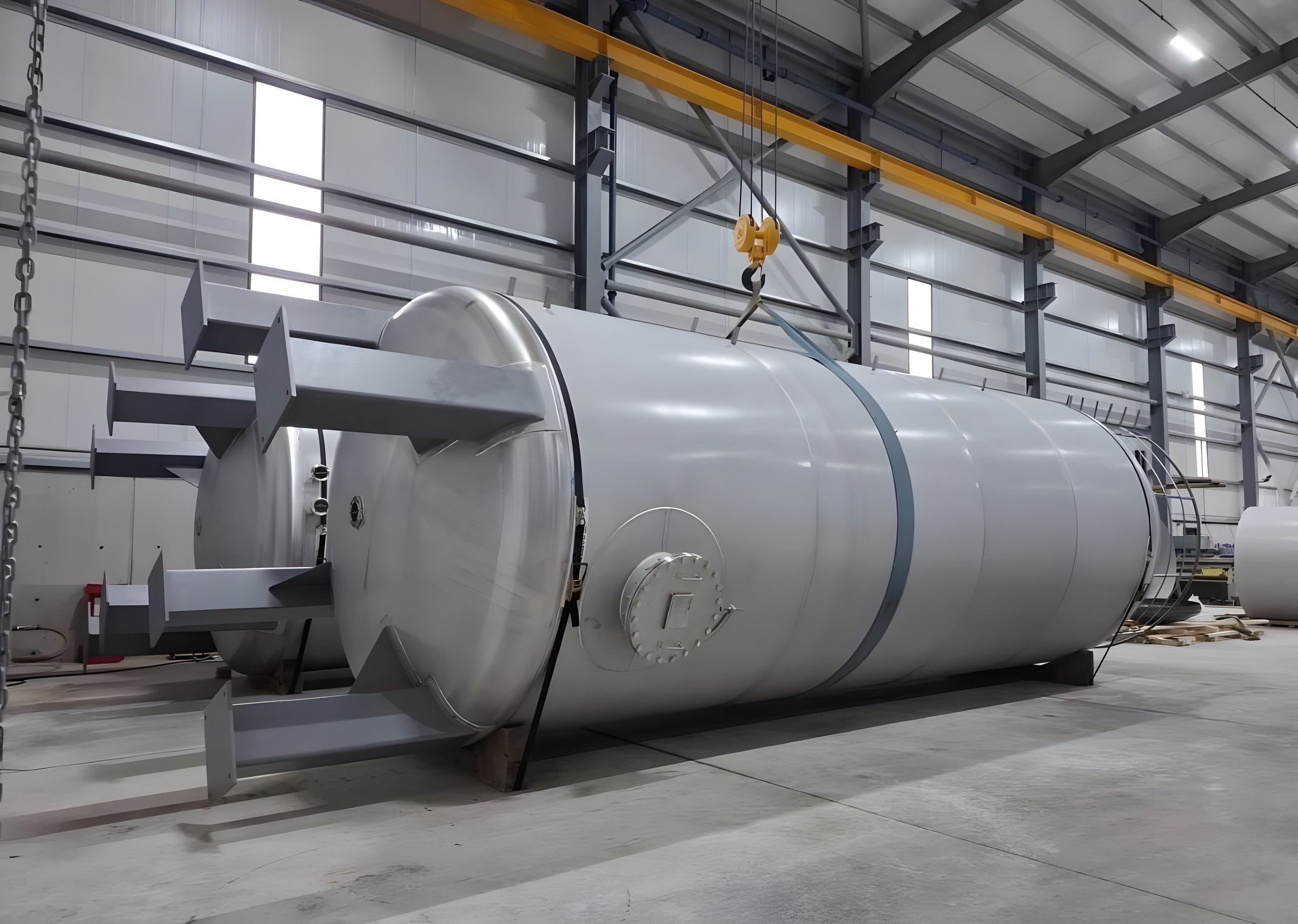
Next, plate rolls curve each plate into a cylinder, known as a shell course or strake. Fitters check the roundness with templates. After that, they tack the long seam.
3. Forming the heads
The ends of the vessel are dished heads. Common shapes are ellipsoidal, torispherical and hemispherical. Specialist presses form them, so many fabricators buy heads from a head maker. In contrast, flat ends appear only on small, low pressure vessels, because they need much thicker plate.
4. Fit-up
Fitters then join shell courses to each other and to the heads. They stagger the long seams, check alignment and control the root gap. Because errors here affect every later weld, the inspector usually examines the fit-up.
5. Welding
Qualified welders make the seams to an approved welding procedure. Workshops often use submerged arc welding for long shell seams, since it gives deep, consistent welds. Meanwhile, welders use stick, MIG or TIG welding for nozzles and attachments.
6. Nozzles and attachments
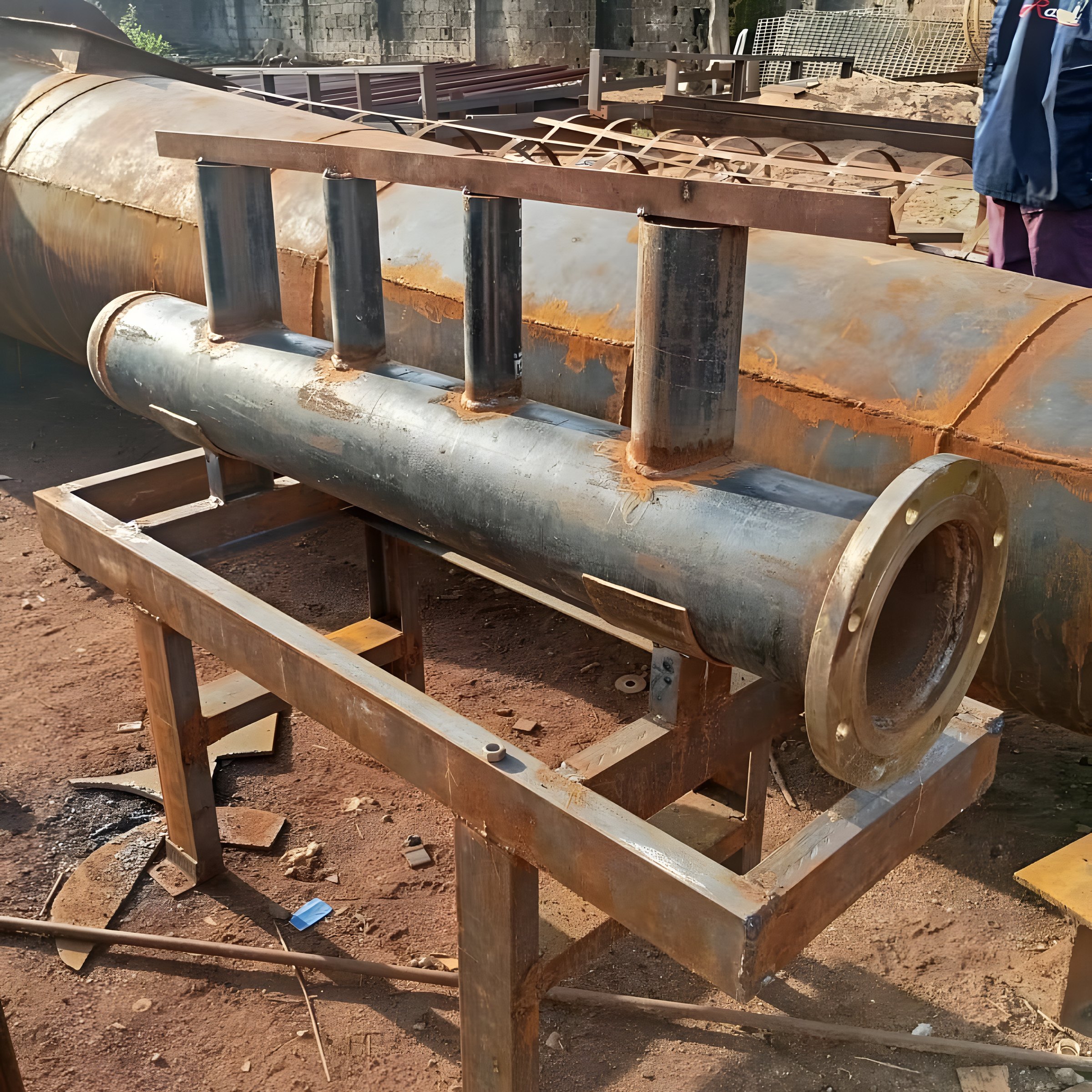
After that, the team cuts openings and welds in nozzles, manways, lifting lugs and supports. Larger openings need reinforcing pads. The orientation of each nozzle must match the drawing exactly, or the site piping will not fit.
7. Non-destructive testing
Then the welds face examination. Depending on the code and the design, the main seams get full or spot radiography or ultrasonic testing. Nozzle welds usually get magnetic particle or dye penetrant testing. Our guide to weld inspection explains each method.
8. Heat treatment
Thick sections and some materials need post-weld heat treatment. A furnace heats the vessel slowly, holds it at temperature and cools it in a controlled way. This relieves the stresses that welding leaves in the steel.
9. Pressure testing
Next comes the proof test. The fabricator fills the vessel with water, removes the air and raises the pressure above the design figure, as the code requires. Then the inspector examines every weld and joint for leaks. We describe the method in our guide to hydrostatic testing.
10. Finishing
Finally, workers drain and dry the vessel. Carbon steel gets blast cleaning and paint. Stainless steel gets pickling and passivation. The fabricator then fixes the nameplate, protects the nozzles and prepares the vessel for transport.
What does the nameplate tell you?
The nameplate is the vessel’s identity, and it marks the end of pressure vessel fabrication. It normally shows the manufacturer, the serial number, the year, the design code, the design pressure and temperature, the test pressure and the capacity.
Never remove or paint over it. Inspectors rely on it throughout the life of the vessel. If a vessel has no nameplate and no records, treat it with great caution.
Which documents complete pressure vessel fabrication?
A vessel without paperwork is hard to insure and hard to certify. So the purchase order should require a manufacturer’s data book. It normally contains:
- approved drawings and design calculations
- material test certificates, with a traceability map
- welding procedures and welder qualifications
- a weld map and NDT reports
- heat treatment charts, where they apply
- the hydrotest certificate
- dimensional and visual inspection reports
- the nameplate details
- coating records
Keep this book safely for the life of the vessel. Later inspections, repairs and resale all depend on it.
What safety devices does a vessel need?
Good pressure vessel fabrication is only part of safety. In service, each vessel needs protection.
First, a safety relief valve must stop the pressure from exceeding the design limit. Engineers size and set it for the vessel, and a competent person tests it regularly. Second, a pressure gauge shows the operator what is happening. Third, a drain removes condensate, which is especially important on air receivers.
Never fit an isolation valve between the vessel and its relief valve without a locked-open arrangement. Otherwise, somebody may close it and leave the vessel unprotected.
How should owners inspect vessels in service?
Vessels age. Corrosion thins the wall, and cycles of pressure fatigue the welds. Therefore, owners need a routine.
- Regularly. Check for external corrosion, leaks, damaged supports and blocked drains.
- Periodically. A competent inspector measures wall thickness with ultrasonic equipment and examines welds.
- At intervals set by regulation. The vessel undergoes statutory examination and, where required, a pressure test.
In Nigeria, factory regulations require periodic examination of steam and air receivers and other pressure plant. So keep the certificates on file, and act on the inspector’s findings.
What affects the cost of pressure vessel fabrication?
Several factors drive the price.
- Size and pressure. Both increase the plate thickness and weight.
- Material. Stainless and alloy steels cost several times more than carbon steel.
- Code and inspection level. Full radiography and third-party inspection add cost.
- Heat treatment. It needs furnace time and transport.
- Nozzles and internals. Complex designs take more hours.
- Coating or lining. Special linings add a further stage.
- Delivery. Large vessels need escorts and cranes.
A complete data sheet lets fabricators quote accurately. As a result, you can compare offers on the same basis.
Frequently asked questions about pressure vessel fabrication
What is the most common code for pressure vessel fabrication?
ASME Section VIII, Division 1, is the most widely used code for unfired pressure vessels. European projects often use EN 13445 instead.
How thick is a pressure vessel wall?
It depends on the pressure, the diameter, the material and the corrosion allowance. The design code gives formulas, so the designer calculates the thickness for each vessel.
Does every pressure vessel need a hydrotest?
In almost all cases, yes. The code requires a pressure test after fabrication and before the vessel enters service.
Can a damaged pressure vessel be repaired?
Often it can. However, a qualified organisation must carry out the repair to the original code, with approved procedures, testing and records.
Buy the vessel and the proof together
Sound pressure vessel fabrication combines correct design, certified steel, qualified welding and thorough testing. The data book proves that all four happened.
Maven Technical Services fabricates pressure vessels, headers and tanks at our own facility in Lagos, with certified welders and documented inspection. See our workshop fabrication work, or send our engineers your data sheet for a method, a schedule and a price.