In this article
- What is a pressed steel tank?
- The main parts of a pressed steel tank
- How big can a pressed steel tank be?
- How do you size the tank for your site?
- What foundation does a pressed steel tank need?
- How is a pressed steel tank installed?
- Which finish should you choose?
- Pressed steel tank or another type?
- What affects the cost?
- How do you maintain a pressed steel tank?
- Which standards apply?
- Frequently asked questions about pressed steel tanks
- Get the tank that fits your site
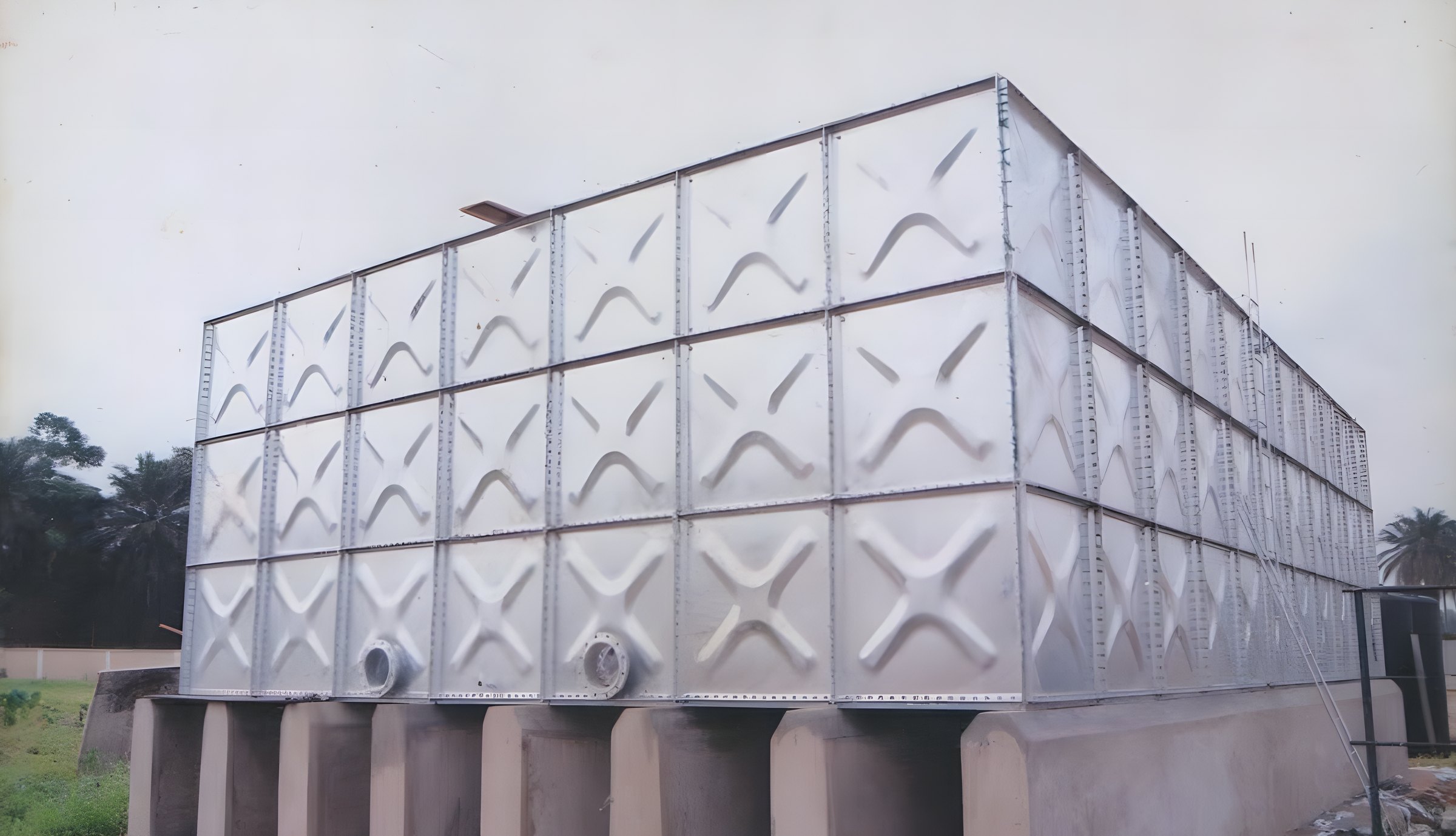
A pressed steel tank is a rectangular water tank that installers bolt together on site from square steel panels. Each panel has pressed ribs and flanged edges, so the tank is strong for its weight. Because it arrives flat-packed, it can reach rooftops, towers and remote sites where a welded tank could never travel.
As a result, factories, estates, hospitals and fire systems across Nigeria rely on this design. This guide explains how a pressed steel tank works, how to size it, how installers build it and how to make it last.
What is a pressed steel tank?
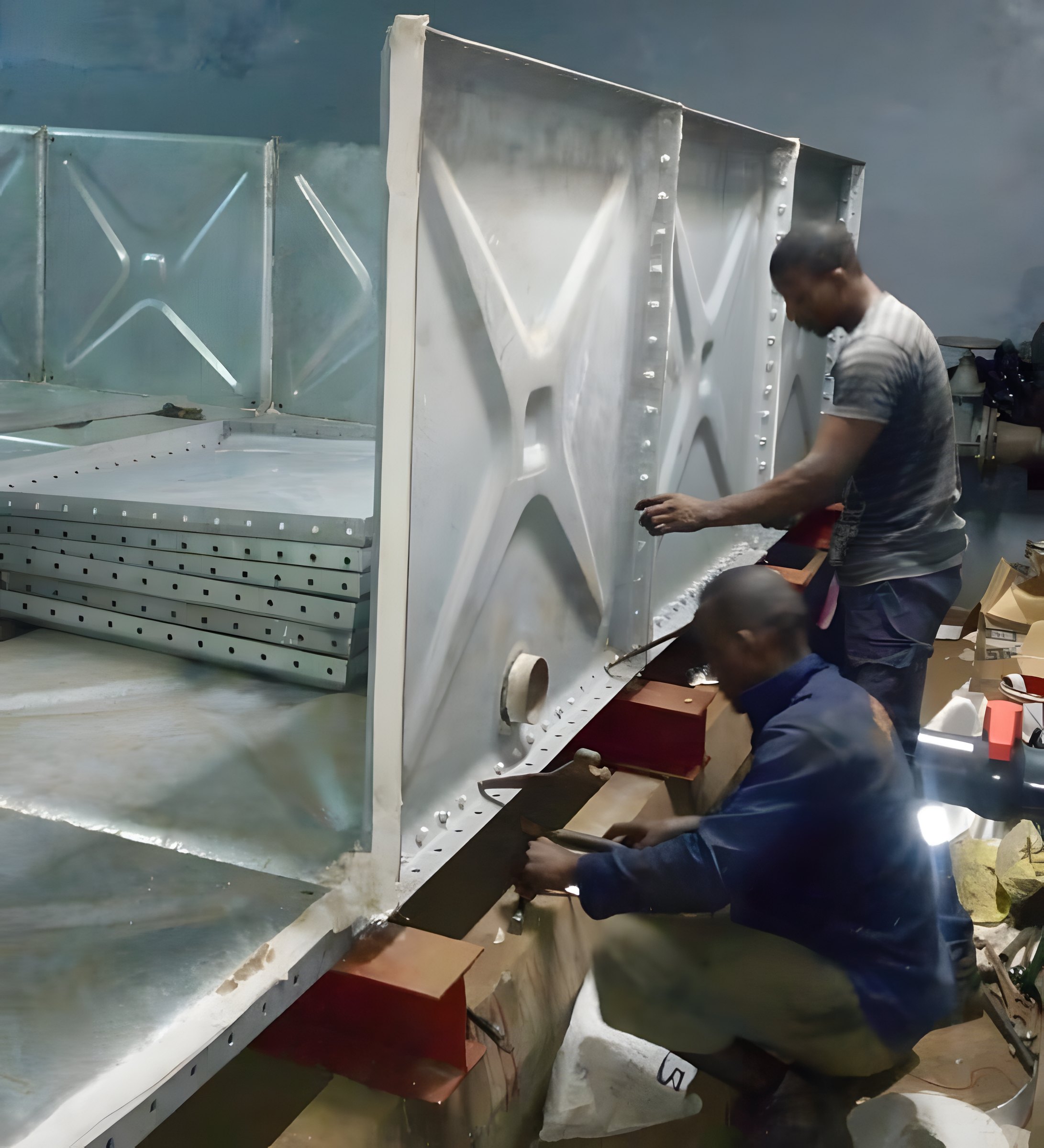
It is a sectional tank. The basic unit is a steel panel, most often 1.22 metres square, which is four feet by four feet. First, a press forms a stiffening pattern into each panel and turns up the edges into flanges.
Then installers bolt the panels together through the flanges, with a sealing strip between them. Inside, steel stays tie the walls to each other and to the base. So the walls do not bulge when the tank is full.
Because the panels are modular, the tank can be almost any length, width and height. It can also grow later, since installers can add more panels.
The main parts of a pressed steel tank
| Part | Purpose |
|---|---|
| Base, side and corner panels | Form the body of the tank |
| Roof panels | Keep out light, dust, insects and rain |
| Internal stays and cleats | Brace the walls against water pressure |
| Sealing strip or mastic | Makes the bolted joints watertight |
| Bolts, nuts and washers | Hold the panels together |
| Internal partition | Splits the tank so one half can stay in service |
| Manhole, ladders and vent | Give safe access and airflow |
| Inlet, outlet, overflow and drain | Connect the tank to the pipework |
| Level indicator | Shows the water level from the ground |
How big can a pressed steel tank be?
In short, capacity follows from the panel count. As a simple guide, one cubic metre holds 1,000 litres. Therefore, a tank that measures 4.88 by 4.88 by 2.44 metres holds about 58,000 litres.
In most cases, common heights run from one panel to four panels, which is 1.22 to 4.88 metres. Taller tanks need thicker bottom panels, because water pressure rises with depth. For that reason, the maker specifies plate thickness for each tier.
The table shows a few typical sizes.
| Length x width x height (m) | Nominal capacity (litres) |
|---|---|
| 2.44 x 2.44 x 2.44 | 14,500 |
| 3.66 x 2.44 x 2.44 | 21,800 |
| 4.88 x 4.88 x 2.44 | 58,100 |
| 7.32 x 4.88 x 3.66 | 130,700 |
| 9.76 x 7.32 x 3.66 | 261,500 |
Usable volume is a little lower than the nominal figure. After all, the overflow sits below the roof, and the outlet sits above the floor.
How do you size the tank for your site?
Start with daily demand. First, add up what the plant, the building or the estate uses in a day. Then decide how many hours or days of reserve you want. In areas with unreliable supply, many owners hold at least one full day.
Next, add any fire reserve. For example, a fire hydrant system needs a dedicated volume that normal use cannot touch. We explain that in our guide to the fire hydrant system.
Finally, check the space and the structure. In addition, a tank on a roof or tower must suit the load the structure can carry. After all, water is heavy: every cubic metre weighs a tonne.
What foundation does a pressed steel tank need?
In fact, the tank does not sit flat on a slab. Instead, it rests on a series of parallel supports, so that air can reach the underside and bolts stay accessible.
At ground level, builders usually cast concrete dwarf walls or piers. Then steel bearer beams sit on top, spaced to match the panel joints. However, the supports must be level within a few millimetres. Otherwise, the panels strain and the joints leak.
For elevated tanks, a steel tower carries the bearers. Therefore, the tower needs proper design for the full weight of water, plus wind load. In addition, the foundation under the tower must suit the soil. This is structural work, and we cover it in our guide to structural steel fabrication.
How is a pressed steel tank installed?
Erection follows a set order.
- Check the supports. The team confirms levels, spacing and alignment.
- Lay the base. Installers place the base panels, fit sealing strip and bolt them loosely.
- Erect the walls. Side and corner panels go up tier by tier, with sealant at each joint.
- Fit the stays. Internal braces tie the walls and base together.
- Tighten the bolts. The team tightens in sequence, so that the sealant compresses evenly.
- Fit the roof and accessories. Roof panels, manholes, ladders, vents and nozzles follow.
- Connect the pipework. Inlet, outlet, overflow and drain lines join the tank.
- Fill and test. The team fills the tank in stages and inspects every joint.
- Clean and disinfect. For drinking water, the tank is cleaned and disinfected before use.
A small crew can build a medium tank in a few days. However, care at the joints matters more than speed. Most leaks come from dirty flanges, damaged sealant or uneven tightening.
Which finish should you choose?
The coating decides how long the tank lasts. There are three common options.
Hot-dip galvanised. First, the maker dips each finished panel in molten zinc. As a result, the zinc protects the steel inside and out, including the edges and bolt holes. For most water storage, this is the standard choice.
Painted or epoxy coated. Some tanks have a primer and paint system, often red oxide outside and a water-safe coating inside. It costs less at first. Still, it needs more upkeep.
Stainless steel. Stainless panels suit corrosive water or very long design lives, at a higher price.
For drinking water, make sure that every internal coating and sealant is safe for potable use. So ask the supplier for the certificate.
Pressed steel tank or another type?
Each kind of tank has its place. The table compares the main options.
| Feature | Pressed steel tank | Welded steel tank | GRP sectional tank | Plastic tank |
|---|---|---|---|---|
| Transport | Flat-packed, easy | Bulky or built on site | Flat-packed | Bulky |
| Large capacity | Yes | Yes, very large | Yes | Limited |
| Roof or tower use | Very suitable | Difficult | Suitable | Small sizes only |
| Strength | High | Highest | Moderate | Low |
| Corrosion | Needs galvanising or coating | Needs coating | Does not rust | Does not rust |
| Sunlight | Unaffected | Unaffected | Can degrade over time | Can degrade over time |
| Extension later | Easy | Hard | Easy | Not possible |
Choose a welded tank for very large volumes, fuel, chemicals or pressure. Our guide to storage tank fabrication in Nigeria covers that route. For water storage on roofs, towers and tight sites, a pressed steel tank is usually the practical answer.
What affects the cost?
Several things decide the price.
- Capacity. More panels mean more steel.
- Height. Taller tanks need thicker lower panels.
- Finish. Galvanised and stainless cost more than painted steel.
- Support. For example, a tower can cost as much as the tank itself.
- Accessories. Partitions, ladders, level gauges and covers add up.
- Location. Transport and site access affect labour and logistics.
- Steel prices and exchange rates. Both move, so quotes have short validity.
Ask each supplier to state the plate thickness, the coating, the standard and what the price includes. Then you can compare offers fairly.
How do you maintain a pressed steel tank?
A sectional tank can serve for decades with simple care.
Every month. Walk around the tank. First, look for weeping joints, rust stains, damaged coating and loose covers. Also check that the vent mesh is intact.
Every six months. Inspect the inside through the manhole. Check stays, bolts and the coating at the water line, where corrosion starts first.
Every year. Drain, clean and disinfect the tank. A partition helps here, because one half can keep supplying water while the team cleans the other. Then repair any damaged coating with a suitable paint.
As needed. Tighten weeping joints, and replace corroded bolts. Do not let small leaks run for months, since constant wetting speeds up rust.
Finally, keep the roof closed and the overflow screened. Light encourages algae, and open gaps let in insects and dust.
Which standards apply?
The best-known standard is BS 1564, the British Standard for pressed steel sectional rectangular tanks. It sets panel sizes, plate thickness and construction details. You can find it through the British Standards Institution. Many projects also name a galvanising standard and a potable water approval.
Frequently asked questions about pressed steel tanks
How long does a pressed steel tank last?
A hot-dip galvanised tank with regular maintenance can last 20 years or more. Coating quality, water chemistry and upkeep decide the real figure.
What is the size of one pressed steel tank panel?
The most common panel is 1.22 metres square, which equals four feet by four feet. Some makers also offer one metre panels.
Can a pressed steel tank be installed on a roof?
Yes. Its flat-packed panels travel easily to roof level. However, an engineer must first confirm that the structure can carry the full weight of water.
Why is my sectional tank leaking at the joints?
The usual causes are uneven supports, loose bolts or aged sealant. Tighten the bolts in sequence first. If the leak continues, the joint may need new sealant.
Get the tank that fits your site
A pressed steel tank gives flexible, strong water storage almost anywhere. With level supports, careful assembly and yearly cleaning, it will serve for many years.
Maven Technical Services fabricates and installs industrial tanks, towers and pipework across Nigeria. View our tank fabrication and installation projects, or ask our engineers for a size and price for your site.