In this article
- What is a boiler economiser?
- How does a boiler economiser work?
- How much can a boiler economiser save?
- Types of boiler economiser
- What is the acid dew point, and why does it matter?
- When is a boiler economiser worth fitting?
- What does installation involve?
- Why fit a bypass?
- How do you operate and maintain a boiler economiser?
- Which mistakes shorten its life?
- How does it compare with other heat recovery options?
- Frequently asked questions about boiler economisers
- Recover the heat you have paid for
A boiler economiser is a heat exchanger in the flue gas path that uses waste heat to warm the feed water before it enters the boiler. It typically cuts fuel use by four to six percent. On a boiler that runs long hours, that saving often repays the cost within one to three years.
Flue gas leaves most boilers at 200 degrees Celsius or more. That heat is fuel you have already paid for. This guide explains how a boiler economiser captures it, what can go wrong and how to decide whether one suits your plant.
What is a boiler economiser?
It is a bank of tubes that sits between the boiler outlet and the chimney. Feed water flows inside the tubes on its way to the boiler. Meanwhile, hot flue gas flows over the outside.
Heat passes from the gas to the water. As a result, the gas leaves cooler and the water arrives hotter. Because the boiler then has less heating to do, the burner uses less fuel for the same steam.
The idea is old and proven. In fact, large power and process boilers have used economisers for well over a century. Today, makers also offer compact units for packaged shell boilers.
How does a boiler economiser work?
The principle is simple heat exchange. Three details make it effective.
Counter flow. First, designers usually arrange the water to flow against the gas. The coldest water then meets the coolest gas, and the hottest water meets the hottest gas. This layout recovers the most heat.
Extended surface. Second, gas transfers heat poorly compared with water. So most economisers for clean fuels use finned tubes, which give far more surface on the gas side.
Pressure rating. Third, the tubes carry feed water at full boiler pressure. Therefore, an economiser is a pressure part, with the same demands for welding, testing and certification as the boiler itself.
How much can a boiler economiser save?
A useful rule of thumb links flue gas temperature to efficiency. Every 20 degrees Celsius that you take out of the flue gas improves boiler efficiency by about one percent.
Consider an example. A gas fired boiler sends flue gas to the chimney at 230 degrees. An economiser cools that gas to 140 degrees, a drop of 90 degrees. Efficiency therefore rises by roughly four and a half percent.
The feed water gains the same heat. In a typical case, it enters the economiser at about 100 degrees and leaves 20 to 30 degrees hotter. That fits another rule: every six degrees of extra feed water temperature saves about one percent of fuel.
The table shows how the saving scales.
| Flue gas temperature drop | Approximate efficiency gain |
|---|---|
| 40 degrees C | 2 percent |
| 60 degrees C | 3 percent |
| 80 degrees C | 4 percent |
| 100 degrees C | 5 percent |
| 120 degrees C | 6 percent |
Actual results depend on the fuel, the excess air and the load. So ask the supplier for a guaranteed performance figure at your operating conditions.
Types of boiler economiser
Several designs exist. The right one depends mainly on the fuel.
| Type | Description | Best for |
|---|---|---|
| Finned tube | Tubes with spiral or plate fins | Natural gas and clean diesel |
| Bare tube | Plain tubes, easy to clean | Furnace oil, biomass, dusty gas |
| Cast iron gilled | Cast iron sleeves over steel tubes | Fuels that contain sulphur |
| Condensing | Cools gas below its dew point | Natural gas, with low temperature water to heat |
Finned tubes are compact and efficient. However, the fins trap soot and ash. For that reason, plants that burn furnace oil or biomass usually choose bare tubes with wider spacing, plus soot blowers.
A condensing economiser goes further. It cools the gas until the water vapour in it condenses, which releases extra heat. It can lift efficiency well beyond a standard unit. Yet it needs corrosion resistant materials and a use for low temperature hot water.
What is the acid dew point, and why does it matter?
This is the main risk with any boiler economiser. Fuels that contain sulphur produce sulphur oxides when they burn. If the flue gas or the tube surface cools too far, those oxides combine with moisture and form sulphuric acid.
The acid then attacks the tubes and the ducting. In severe cases, an economiser can fail within a couple of years.
The safe limit depends on the fuel.
- Natural gas contains almost no sulphur. So the gas can be cooled a long way, often to around 120 degrees or lower.
- Diesel contains some sulphur, so designers keep the exit temperature higher.
- Furnace oil contains the most. Therefore, the gas exit temperature and the feed water inlet temperature must both stay well above the acid dew point.
The feed water temperature matters as much as the gas temperature. Cold feed water chills the tube metal, and acid forms on it even when the bulk gas is hot. So an economiser works best with feed water from a deaerator or a hot feed tank. Good condensate return helps here, as we explain in our guide to condensate recovery.
When is a boiler economiser worth fitting?
Not every boiler justifies one. The case is strongest when most of these apply.
- The boiler runs for long hours, ideally two or three shifts.
- Its load is steady and fairly high.
- Flue gas leaves at more than about 200 degrees.
- Your fuel is clean, such as natural gas.
- Fuel is expensive.
- There is space in the flue path and spare fan capacity.
On the other hand, the case is weak for a small boiler that runs a few hours a day. The saving is real, but the hours are too few to repay the cost.
To estimate payback, follow three steps. First, take your yearly fuel bill. Next, multiply it by the expected saving, such as four or five percent. Finally, divide the installed cost by that yearly saving. Many plants with long running hours see payback in one to three years.
What does installation involve?
Fitting an economiser to an existing boiler is a modest project, but it touches several systems.
- Survey. Engineers measure flue gas temperature, flow, draught and feed water conditions.
- Design. The supplier sizes the unit and confirms the performance and the pressure drop.
- Structure. The economiser is heavy when full, so it needs its own support steel.
- Ducting. Fabricators modify the flue duct, and often add a bypass with dampers.
- Feed water piping. New pipework takes water from the feed pump through the economiser to the boiler.
- Safety devices. If valves can isolate the unit, it needs its own safety valve.
- Instruments. Thermometers and gauges go on the water and gas sides, at inlet and outlet.
- Insulation. The casing, ducts and pipes are insulated and clad.
- Testing and commissioning. The team pressure tests the water side, checks the draught and records the performance.
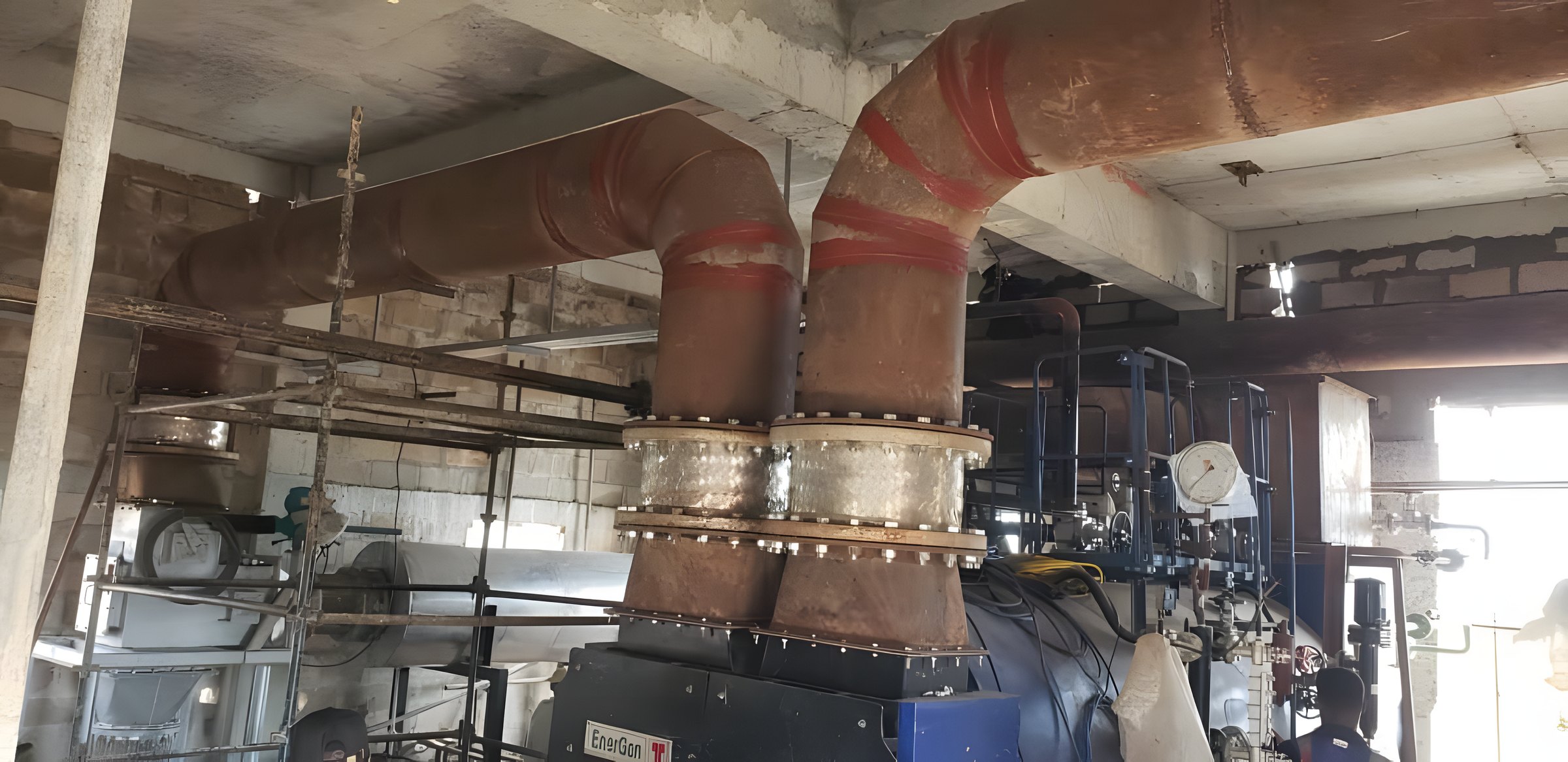
Two checks deserve special attention. First, the extra resistance in the gas path must not starve the burner, so engineers confirm that the fan can cope. Second, the feed pump must overcome the added pressure drop on the water side.
Most of this is fabrication and piping work, which a contractor with its own workshop can prepare in advance. Then the tie-in fits within a short shutdown. For a related project, see our waste heat recovery boiler work for Green Hills in Benin City.
Why fit a bypass?
A gas bypass lets the flue gas go straight to the chimney. It protects the unit in three situations.
First, during a cold start, the gas and the tubes are cool, and acid can form. Second, when the boiler switches to a high sulphur standby fuel, the economiser may need to come out of service. Third, if the unit ever leaks, the boiler can keep running while the plant waits for a repair.
Water must always flow through the tubes while hot gas passes over them. Otherwise, the water inside can boil and damage the unit. So the controls and the operating procedure must make that clear.
How do you operate and maintain a boiler economiser?
An economiser has no moving parts, but it does need attention.
- Log the temperatures. Record gas in, gas out, water in and water out every day. A rising gas outlet temperature means the surface is fouling.
- Keep it clean. Use soot blowers where fitted, and wash or brush the tubes during shutdowns.
- Watch the draught. A rising pressure drop on the gas side also signals fouling.
- Control water quality. Dissolved oxygen in feed water pits the tubes from inside. Our boiler water treatment guide explains the controls.
- Inspect each year. Check for corrosion, leaks, damaged fins and worn insulation. Test the safety valve.
- Avoid cold feed water. Keep the inlet temperature above the limit the supplier states.
Which mistakes shorten its life?
- fitting a finned unit on a dirty fuel
- feeding it with cold water
- cooling the gas below the acid dew point
- leaving out the bypass
- ignoring fan and feed pump capacity
- never cleaning the gas side
- isolating the water side with hot gas still flowing
How does it compare with other heat recovery options?
An economiser is one of several ways to recover flue heat. An air preheater, for example, warms the combustion air instead of the feed water. Large biomass and water tube boilers often have both. A waste heat recovery boiler, in contrast, makes steam from the exhaust of an engine, kiln or furnace.
For most shell boilers, the economiser is the simplest and most cost-effective choice. For the full list of fuel-saving measures, see our guide on how to improve boiler efficiency. The US Department of Energy also publishes a steam tip sheet on feed water economisers.
Frequently asked questions about boiler economisers
How much fuel does a boiler economiser save?
A standard unit usually saves four to six percent of fuel. A condensing unit on natural gas can save more, where the plant can use low temperature hot water.
Can you fit an economiser to an existing boiler?
Yes, in most cases. The project needs space in the flue path, support steel, feed water piping and enough fan and pump capacity.
Does an economiser work with furnace oil?
It can, with care. Use bare or cast iron tubes, keep the exit gas and the feed water hot enough to avoid acid, and clean the surface often.
What is the difference between an economiser and an air preheater?
Both recover flue gas heat. An economiser heats the feed water, while an air preheater heats the combustion air.
Recover the heat you have paid for
A boiler economiser turns chimney heat into lower fuel bills. With the right type for your fuel, hot feed water and regular cleaning, it gives many years of savings.
Maven Technical Services installs and maintains boilers, economisers and heat recovery systems across Nigeria, and we are the appointed partner of Thermax for boiler installation and maintenance. Ask our engineers for a survey and a payback estimate for your boiler.